Interview: A Hay-on-Wye Author on Writing in a Town of Bookshops

Interview: A Hay-on-Wye Author on Writing in a Town of Bookshops
Hay-on-Wye has a castle, a clock tower, and more bookshops than any small town reasonably needs. It also has Mared Llewellyn, who has lived here for eleven years and writes fiction in two small rooms above a secondhand shop on one of the lanes off the main street.
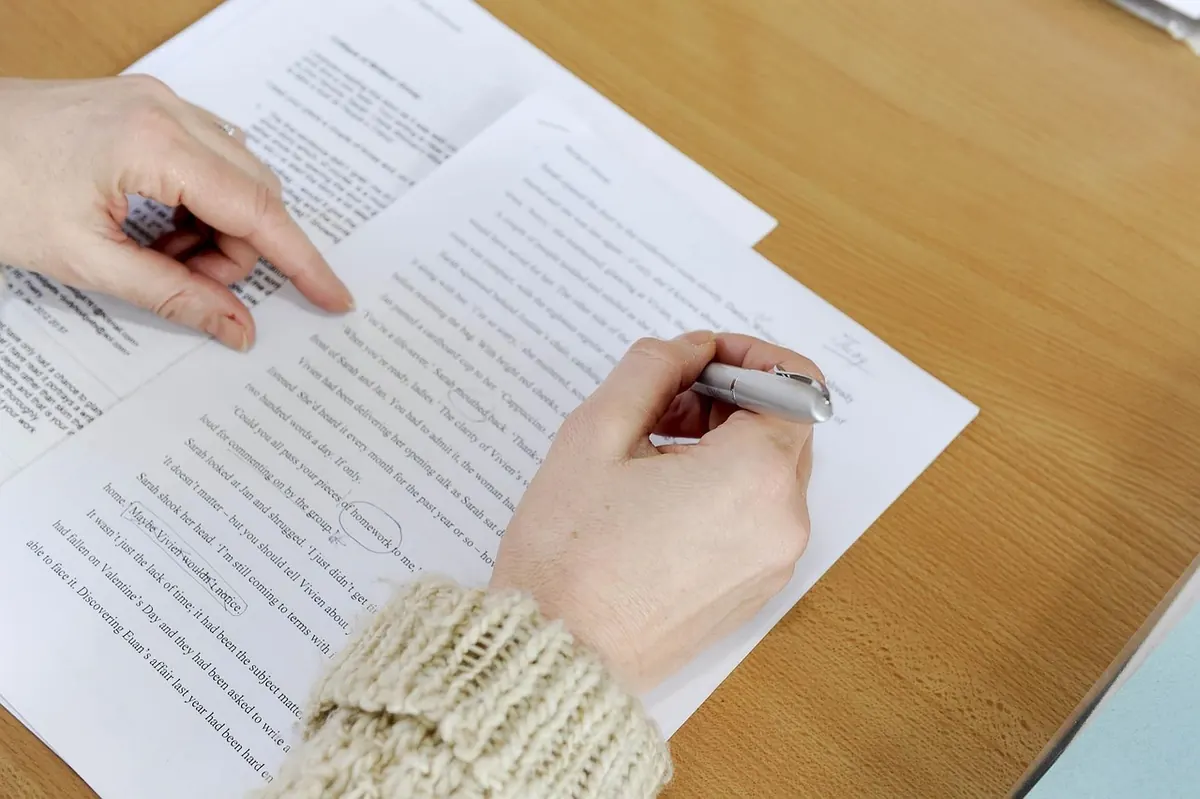
We talked over tea at a kitchen table that doubles as a desk: notebooks stacked at one end, a ring-marked manuscript page, a paperback laid face-down to hold a place. The conversation has been edited for length and clarity.
The writing room above the shop
The flat is small, the ceiling low, and the window looks out over rooftops towards the castle. From below come the sounds of the shop: the bell on the door, the low murmur of browsers, the thump of a box of books being shifted across the floor.
"People assume I moved here to be inspired," she says. "The real answer is that I came for a job, stayed for a person, and then noticed the town made a certain kind of writing life possible. I didn't choose it deliberately. I just stopped fighting it."
She has come to rely on that background noise. "Total silence makes me self-conscious. Hearing someone downstairs deciding whether to buy a book reminds me that books are objects made by people and carried home in bags. It keeps me from taking myself too seriously."
She also likes the view for a less romantic reason: the castle gives her a fixed point to stare at when a sentence won't come. "You need somewhere to put your eyes that isn't the screen. A wall works. A castle works better."
A working day shaped by opening hours
Most writers organise their week around their own energy. Llewellyn organises hers around a shop that has to open, staff who have to be paid, and a delivery van that arrives when it arrives.
"The shop saved me from my worst habit, which was waiting to feel like writing," she says. "You can't wait when you've got ninety minutes before you need to be downstairs."
Her week looks roughly like this:
- Mornings before opening are for the new book. No email, no social media, no tidying. She drafts by hand in a cheap exercise book because "a laptop invites me to edit sentences that don't exist yet".
- The middle of the day belongs to the shop. Shelving, orders, customers, the endless business of moving stock from one place to another.
- Late afternoon is for admin and correspondence. She treats it as a separate job, which stops it eating the morning.
- Evenings are for reading, usually two books at once — one fiction, one non-fiction, so a slow patch in either doesn't stall her.
- Sunday is off. No writing, no reading for work, no exceptions. "I learned that the hard way after a year of grinding out nothing."
She once tried to reverse the order: write in the evening after a full day in the shop, then sleep late. The result was a month of two-hundred-word days and a bad temper. Now she stops at eleven-thirty if the shop needs her, without guilt. "The shop is not an interruption. It's the clock."
Reading in a town that sells books
The obvious hazard of living here is that you can come home with a stack of books and hardly notice the money leaving your account. Llewellyn's shelves are not immune, but she has rules.
"I only buy what I'll read within the month. Anything else goes on a list, and most of the list quietly dies, which is useful information." She keeps a single shelf by the door for books she has decided not to read, as a reminder that buying and reading are different hobbies.
The bookseller's eye
Working around secondhand stock has changed what she notices. "You handle a lot of books that sold well forty years ago and nobody wants now. It's a good corrective if you're the sort of writer who checks the bestseller lists for reassurance."
It has also made her a promiscuous reader. She reads first pages the way other people skim menus — twenty in an evening, three all the way through. Poetry and essays fill the gaps between novels. "Browsing teaches you that taste is an accident of what you happened to pick up. I try to keep picking things up at random."
When the festival arrives
For a fortnight in late spring the town changes character. The population swells, the lanes fill, the car parks are hopeless, and every conversation within earshot is about books.
It is, she says, wonderful and completely incompatible with drafting. "I plan for it. I do my food shopping before, I walk early, and I don't expect a word on the page. If I'm asked to do an event, I do one and then I go home."
Her other piece of festival advice is less about logistics. "Don't sit in six brilliant talks while you're halfway through a draft. You'll come out convinced there's no point. Watch two events, not six, and leave the rest for the years when you're not writing. The festival will come back. Your draft won't wait."
Revision, rejection, and the usefulness of a small town
Llewellyn's first novel took four years and was rejected by twenty-three publishers. She kept the letters in a shoebox under the bed until the box began to feel like a monument to something she didn't want to worship. Now she keeps only two: the worst one and the one that eventually said yes.
"A rejection letter is just a stranger's opinion delivered at the wrong moment," she says. "The useful ones tell you something about the book. The useless ones tell you something about the stranger. You have to learn to tell them apart."
She credits the town's other writers for keeping her sane. There are novelists, poets, a biographer, and a man who writes long, unpublishable essays about walking. They meet once a month in a back room and talk about work for two hours, then about everything else. No one reads aloud unless they ask. It is, she says, more like a support group with better snacks.
"The town doesn't write the book for you. It just makes the desk cheaper and the company better."
Advice for writing in a bookish town
- Separate the town from the work. Hay-on-Wye is full of readers, but reading about writing is not writing. Llewellyn keeps a strict boundary: the shop is the shop, the desk is the desk.
- Use the shop, don't become it. She sees writers who move here and spend a year arranging shelves and calling it research. "Stocking a bookshop is not a novel. It's a very pleasant way to avoid one."
- Protect a fallow season. After each draft she takes two weeks off from fiction entirely. She reads crime novels, walks the hills, and lets the next book arrive without forcing it.
- Keep a small, unglamorous routine. A cheap notebook, a timer, a set number of pages. The romance of the town is not the routine. The routine is what gets the pages written.
Her own rule is simpler than any of these: "Write before you know what you think. The town will still be here when you come downstairs."
What she's working on now
She is forty thousand words into a novel about a woman who inherits a failing bookshop and a box of letters that may or may not belong to her grandmother. It is set in a town that is not quite Hay-on-Wye, though the lanes are suspiciously familiar.
She won't say more. "Talking about a book too early is like opening an oven every five minutes to check a cake. You let the heat out and then you blame the recipe."
She walks me to the door, past the shelf of books she has decided not to read, and down the narrow stairs. The bell rings as I leave. Behind me, I can hear her shifting a box of books across the floor, back to the other half of her working life.
Photo: Tuur Tisseghem / Pexels